Why Smarter Charging Matters for Modern Travellers
Travelling with tech has gone from a simple phone charger in your bag to a full kit: laptop, phone, tablet, earbuds, smartwatch, and often a power bank as backup. Each device seems to demand its own bulky brick, cable, and sometimes even a power board to fight over the single wall socket in a hotel room or airport lounge. The result is extra weight, cable clutter, and a real risk that one missing charger slows your work day to a crawl.
For frequent travellers, digital nomads and remote workers, charging is not a side issue; it is what keeps income flowing and deadlines under control. When your laptop is your office and your phone is your lifeline, waiting hours for a charge or juggling multiple adapters simply is not good enough. That is why understanding the simple question, what is a GaN charger, actually matters. This is not just another buzzword; it is a genuine shift in how power electronics work, letting you buy smarter, pack lighter and charge faster.
At Chargeasap here in Australia, we have built our gear around this tech, and we will use our Zeus 280W GaN charger as a real-world example of what modern GaN charging can do in a compact, travel-friendly form.
What Is GaN, and How Is It Different From Silicon?
At its core, the answer to what is a GaN charger is pretty straightforward. GaN stands for gallium nitride, a different semiconductor material that replaces traditional silicon inside the charger. The little black box you plug into the wall is full of components that switch electricity on and off extremely quickly, and GaN changes how efficiently those switches work.
Compared with silicon, GaN handles higher voltages and can switch current on and off at much higher frequencies. When a charger can switch faster, it wastes less power as heat and can convert wall power into USB power more efficiently. Less heat means the internal parts can be smaller and can sit closer together without cooking each other.
Here is why that matters in day-to-day use:
- A GaN charger can deliver the same power as an older silicon charger in a much smaller body.
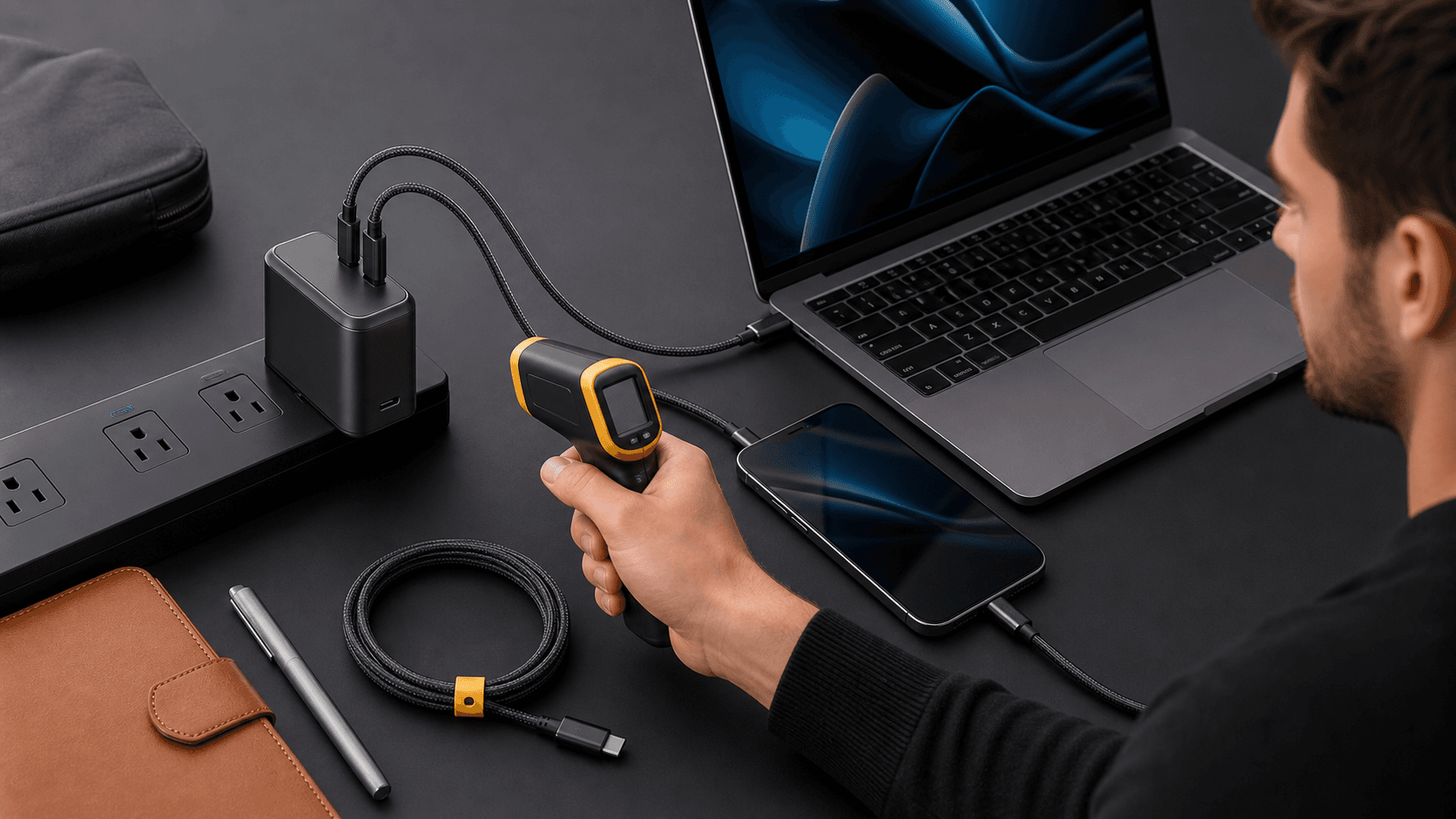
- It stays cooler to the touch, especially under heavy load.
- Efficiency means less energy wasted when you are topping up your devices.
If you have ever lugged around an old-school laptop brick that looks like a small brick in your bag, that is silicon. A modern GaN charger explained simply is a compact unit that can match or exceed that brick’s output, often while also charging your phone and other devices at the same time, all in something closer to a travel adapter than a house brick.
Why GaN Chargers Are Smaller, Faster, and Cooler
Because GaN wastes less power as heat, manufacturers can shrink the size of transformers and other chunky components inside the charger. That is how we get pocket-sized chargers that still deliver serious wattage. Instead of needing a huge casing to handle heat and spacing, the charger can be smaller without sacrificing performance.
Fast charging can sound like marketing jargon, but it really comes down to watts. Watts are just power: the rate at which energy is delivered. The higher the watts, the more power your device can draw, up to the limit it was designed for. When your phone or USB-C PD laptop supports fast charging, a higher watt GaN charger can push more power into it, so it fills up in less time.
Running cooler is not just about comfort. Less heat also brings:
- Safer operation over long charging sessions.
- Better long-term reliability for the internal electronics.
- Space for more ports in a tight case without causing thermal issues.
Our Zeus 280W GaN charger is a good example of this concept in action. It fits multiple high-power USB-C ports, plus extra outputs, into a size that works for travel in a backpack or tech pouch. With traditional silicon, building a multi-port charger at that power level in a similar form factor would have been close to impossible.
Multi-Device Power for Real Travel Setups
Think about a typical remote work setup on the road. You might have: a USB-C laptop for work, a phone for calls and messages, a tablet for reading or drawing, wireless earbuds, and a power bank you top up whenever you find a free outlet. Often, you only get one accessible socket in a hotel, airport seating area or café wall. Something has to miss out.
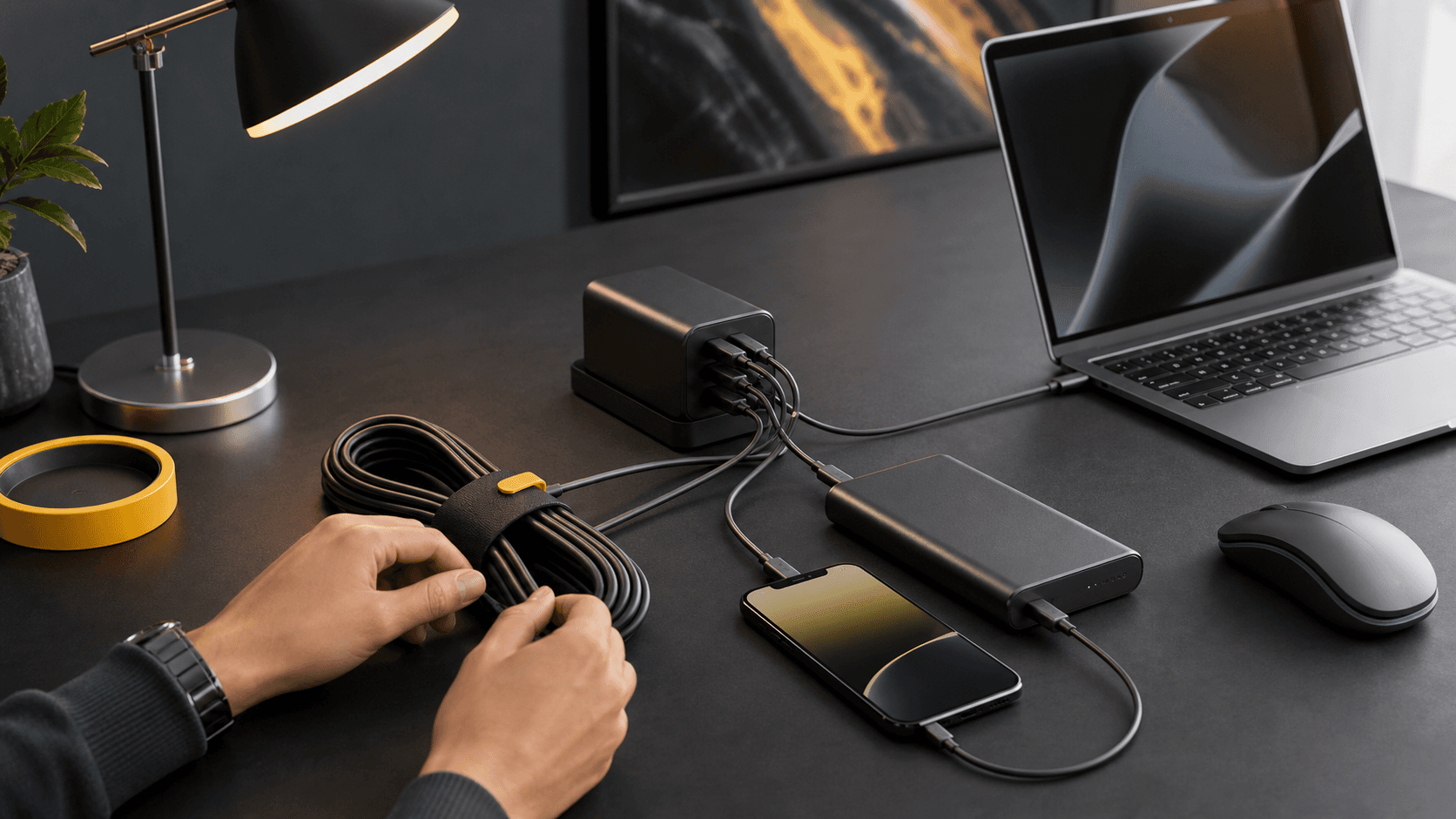
In that context, what is a GaN charger? It becomes a single, high-powered hub that replaces the tangle of separate laptop chargers and phone bricks. With enough total wattage and the right number of ports, one GaN charger clears cable clutter, frees up power points, and means you always know exactly where your main charging gear is.
Modern GaN chargers use smart power distribution. Rather than splitting power rigidly, they dynamically share wattage across ports. For example:
- Plug in a laptop and phone, and the charger can prioritise the laptop while still giving the phone a healthy fast charge.
- Add earbuds and a smartwatch, and the smaller devices sip power without stealing too much from the laptop.
- Disconnect the laptop, and the available power gets redistributed to top up everything else more quickly.
A high-output unit like our Zeus 280W GaN charger is built with this real-world use in mind. It has the headroom to run a laptop plus multiple smaller devices at once from a single wall socket, which is exactly what frequent travellers and digital nomads need in tight power situations.
GaN vs Traditional Laptop Bricks and Phone Chargers
The most obvious difference you notice first is size and weight. A traditional silicon laptop brick plus separate phone and tablet chargers quickly fills a pouch and adds up in your luggage. A GaN charger condenses that into a single compact unit that can sit in a corner of your bag while doing the work of several bricks.
From a performance angle, a good GaN charger usually matches or beats the total wattage of your original laptop brick, and often supports faster charging standards like USB-C PD for laptops and phones that can take advantage of it. Instead of each device needing a different proprietary connector, you can often run everything off USB-C and maybe a legacy USB-A port for older accessories.
There is sometimes a concern that smaller must mean hotter or less safe. With GaN, the opposite is generally true. Because the material is more efficient, the charger can stay cooler for a given output and maintain stable operation under heavy use. Engineers across the tech industry are designing new chargers around GaN, not as a shortcut, but because it is simply a better material for this job. When people say they want a GaN charger explained, the story is essentially that many tech enthusiasts now prioritise GaN for travel and remote work setups since it ticks the boxes of size, speed and efficiency.
How to Choose the Right GaN Charger for Your Gear
Choosing a GaN charger is easier if you follow a short checklist rather than getting lost in specs. Start by adding up the rough power needs of your main devices. Then look at port types and whether you want to replace your laptop brick entirely or just supplement it.
Key things to think about include:
- Total watts: enough to cover your laptop plus phone and at least one or two extra devices.
- Ports: how many USB-C outputs you realistically need, plus any USB-A for older gear.
- Fast charging: support for USB-C PD for laptops, phones and tablets that can use it.
- Size: will it fit in your everyday carry pouch without feeling like a brick?
In simple terms, watts equal how much power a charger can deliver in total. If you plan to charge a laptop and several devices at once, more total watts give you more flexibility so everything can charge at decent speeds. USB-C PD is the common fast charging standard that allows your device and charger to talk to each other and negotiate the right voltage and current safely.
A high-end multi-port unit like the Zeus 280W GaN charger suits power users who run multiple USB-C devices and want a single hub that can replace separate laptop and phone chargers. For lighter setups, smaller GaN chargers and quality cables or power banks can still clean up your carry and give you a taste of the same benefits without overdoing it.
Upgrade Your Everyday Carry with Smarter Charging
We started with one question: what is a GaN charger, and the answer turns out to affect almost everything about how you pack and power your tech. GaN swaps silicon for a more efficient material, which means smaller chargers, higher output, cooler operation and better multi-device support, especially handy if you travel or work remotely.
If your current kit includes a heavy laptop brick, two or three different phone and tablet chargers, and a tangle of cables, it is worth taking a fresh look at what you actually need. A single well-chosen GaN charger can often replace most of that bulk, leaving you with a lighter bag and a simpler setup that is easier to manage on the road. Starting with a powerful multi-port model like our Zeus 280W GaN charger gives you a clear sense of what modern GaN tech can do, and from there you can decide how streamlined you want your everyday carry to be.
Upgrade To Safer, Faster Charging Today
If you are still unsure whether to switch from your old brick charger, our team has broken it down in plain language with What is a GaN charger?. You will see exactly how GaN tech delivers more power in a smaller, cooler and more travel friendly design. At Chargeasap, we build our chargers for Australians who want reliable performance without carrying a heap of bulky gear. Take a look and decide if it is time to refresh how you power your everyday devices.