Stop Letting Your Travel Charger Choke Your Laptop
Traveling with a powerful laptop, phone, tablet, and earbuds should feel freeing, not stressful. If you are still camping beside one airport socket because your small "travel-friendly" charger cannot keep up, the problem is not your devices; it is the charger.
When a charger is too weak or cheaply made, it quietly slows your laptop down. You get slower charging, your battery drains in the background while you work, and sometimes the laptop just shuts off when you push it hard, even while you are plugged into the wall. That is not how your gear is meant to run.
The best travel charger for a laptop and phone is not only small and light. It needs the right power output, the right ports, and smart GaN tech so your laptop can stay at full performance on the road. We will go through how to spot if your current charger is holding you back, what GaN travel chargers change, and what to look for before your next trip.
How Weak Chargers Quietly Slow Down Your Laptop
Every device in your bag expects a certain amount of power. Your laptop, phone, and tablet all have a "power budget" in watts. When the charger cannot give that much, each device has to make a compromise.
You will see this in real life when:
- Video calls drain the battery even though you are plugged in
- Photo or video editing makes the laptop hot and the charge level still drops
- Gaming or running heavy dev tools slowly eats the battery with the charger connected
Under the hood, USB-C Power Delivery (USB-C PD) is trying to match your laptop with the charger. They talk to each other and agree on a safe power level. If the charger is under-specced, your laptop plays it safe. It pulls less power, caps performance, and focuses on just staying on instead of charging fast.
This shows up more during peak travel. Think hot European summer days or packed coworking spaces where your laptop is already warm. You jump between flights, need a quick top-up, and the charger simply cannot push enough power. By the time boarding starts, your battery has barely moved and your laptop is still running in a lower performance state.
What the Best Travel Charger for a Laptop and Phone Needs
So what does a travel charger actually need to keep up with real work, not just light web browsing?
First, power. Many modern laptops alone expect somewhere between 65 and 140 watts. If you also want to charge a phone, tablet, and earbuds, a total shared output of around 200 watts or more gives you breathing room so nothing has to starve.
Next, ports. A strong travel charger should have:
- At least 2 or 3 USB-C ports for your laptop, phone, and tablet
- At least 1 USB-A port for older cables or smaller gadgets
- Clear labels or an easy layout so you know which port is best for your laptop
Smart power distribution matters too. A good charger can shift power between ports based on what is plugged in. Your laptop might get priority power when it is low or working hard, while your phone gets a bit less for a while. This is much better than a charger that just splits power evenly and slows everything down.
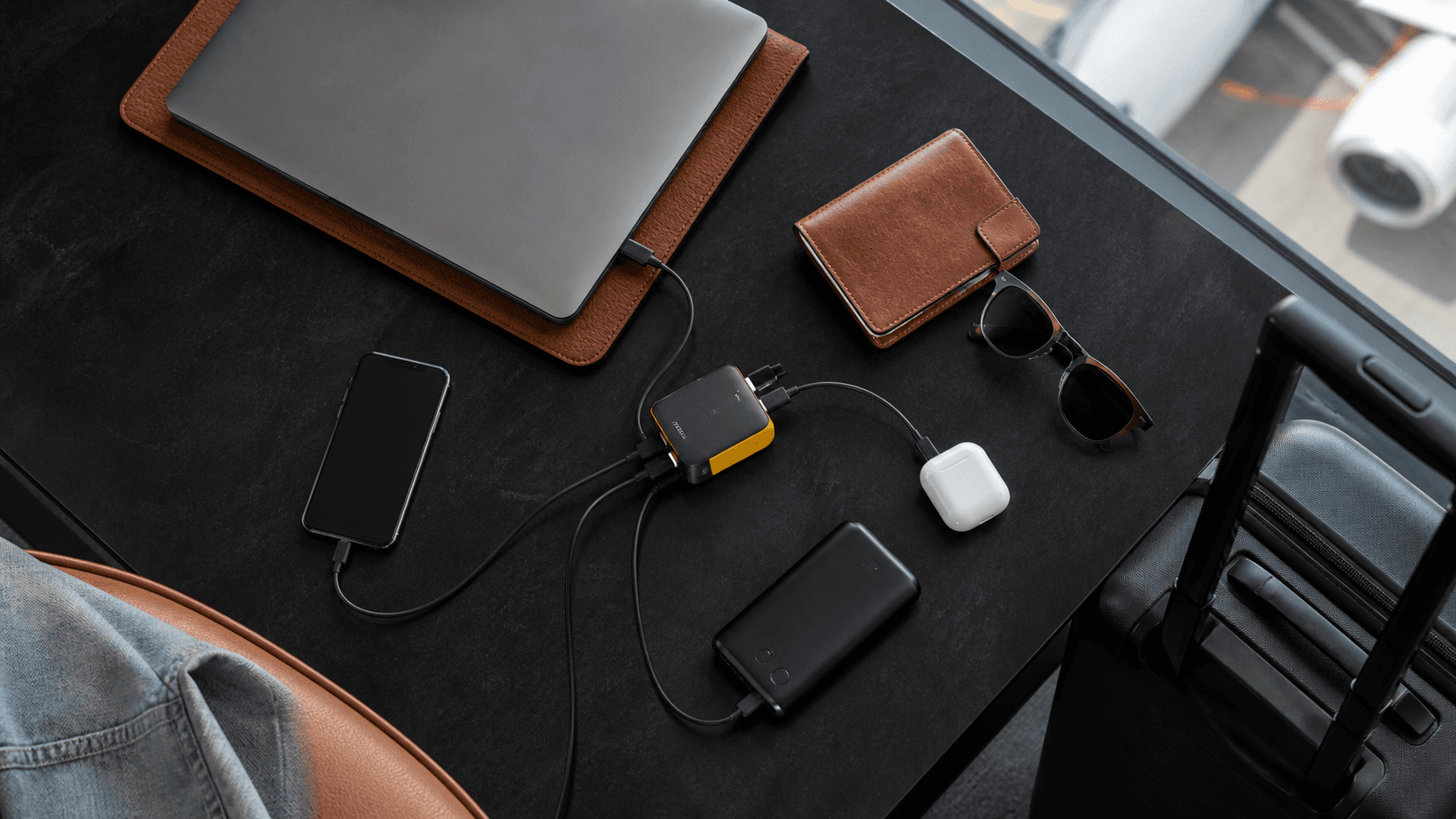
This is where GaN, or Gallium Nitride, comes in. Instead of old-school silicon, GaN lets chargers stay smaller and run cooler while still delivering higher wattage. That means a high-output GaN charger like the Zeus 280W GaN charger can live in your carry-on and still power a demanding laptop setup on the road.
The best travel charger for a laptop and phone is not only about "fast charging." It is about keeping your laptop at full speed while also topping up your phone, tablet, and earbuds at the same time. A quick pre-trip checklist helps:
- Power does it match or beat your laptop's original charger?
- Port mix: enough USB-C and at least one USB-A?
- Plug type: will it work in the countries you are flying to?
- Safety marks: real safety certifications from a brand that takes power tech seriously?
GaN vs. Traditional Bricks in Your Travel Bag
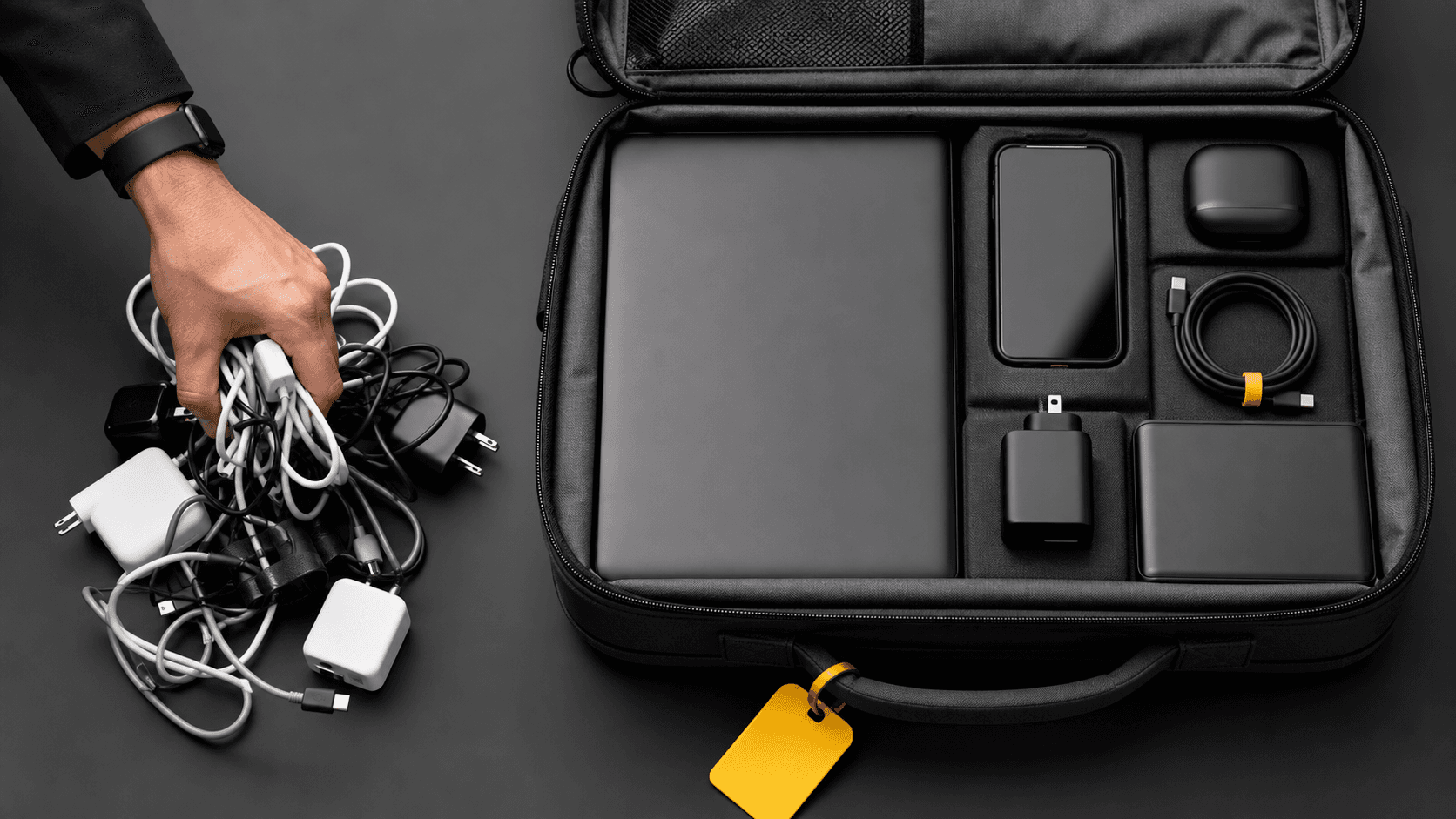
Think about the usual setup. One big OEM laptop brick, one phone charger, maybe another for a tablet, plus plug adapters. That is a lot of weight and clutter in your backpack.
A single high-power GaN travel charger can replace all of those. Compared to the original laptop brick and separate phone charger, a GaN unit:
- Takes less space in your bag or under a hotel desk
- Powers more devices from one outlet at the same time
- Gives you a faster jump from low battery to "good enough to work" during a layover
Because GaN is more efficient, it wastes less energy as heat. The charger stays cooler, even when tucked in with other gear in a hotel room or on a train. Cooler running usually means more stable power to your laptop and less stress on the electronics inside the charger.
In real use, this means:
- A digital nomad can run a USB-C laptop, phone, and tablet from one GaN brick on a tiny Airbnb table
- A frequent traveller can plug in a single charger in hotels, trains, and coworking spaces, instead of juggling multiple bricks and wall adapters
With the right GaN charger, your travel tech feels more like a simple kit and less like a mess of random parts. A compact, high-output option like the Zeus 280W GaN charger is built specifically for this kind of multi-device travel setup.
Smart Packing for Multi-Device Charging Without the Bulk
Mid-year travel is funny for Australians. It might be cool and wet at home while you are flying into hot and sticky northern summers. Space and weight in your bag really matter when you are swapping between climates and airlines.
A simple packing plan helps:
- Carry one high-power GaN charger and a small power board or plug adapter
- Use quality USB-C cables rated for at least 100 watts so your laptop is not limited by a weak cable
- Keep one spare cable in your carry-on in case a checked bag goes missing
Power banks have a role too. They are handy on long flights, trains, or long conference days when outlets are rare. But a power bank is not a full replacement for a strong wall charger. You still need a capable charger to refill both your laptop and the power bank quickly once you reach a hotel or lounge.
Plan your ports as well. Many travellers find it easiest to:
- Dedicate the highest power USB-C port to the laptop
- Use the next USB-C port for the phone
- Use extra ports for earbuds, watches, or tablets overnight
With the best travel charger for a laptop and phone, plus proper cables, your whole charging kit can shrink down to a single pouch. You still charge faster and more reliably than relying on random hotel USB sockets or weak airport chargers.
Upgrade Your Charger, Unlock Your Laptop Performance
If your laptop slows down, drains, or takes ages to charge while you travel, the charger is often the real culprit. An old, low power brick holds back the performance your laptop was designed to give.
A quick gear audit helps:
- Check the wattage written on your current laptop charger
- Compare it with what your laptop maker recommends
- Count how many devices you usually charge at once
- Notice if you are always rotating devices because there is not enough power or ports
Moving to a single, powerful GaN travel charger can replace a pile of separate bricks, cut bulk, and finally let your laptop run at full speed wherever you work. At Chargeasap here in Australia, we build GaN chargers like the Zeus 280W GaN charger with this exact kind of traveller in mind, so your laptop and phone can keep up with you from airport gate to hotel desk.
Travel Smarter With a Charger Built For Every Journey
If you are ready to cut down on clutter in your carry-on and keep every device powered wherever you land, our compact GaN travel adapter is built for you. At Chargeasap, we have designed the best travel charger for a laptop and phone so you can stay connected and charged with a single reliable device. Make your next trip simpler, safer and more efficient by upgrading your charger before you head to the airport.